
Chicago’s Air Quality Reached Hazardous Levels Today. Here’s What Every Homeowner Should Know About Their HVAC System
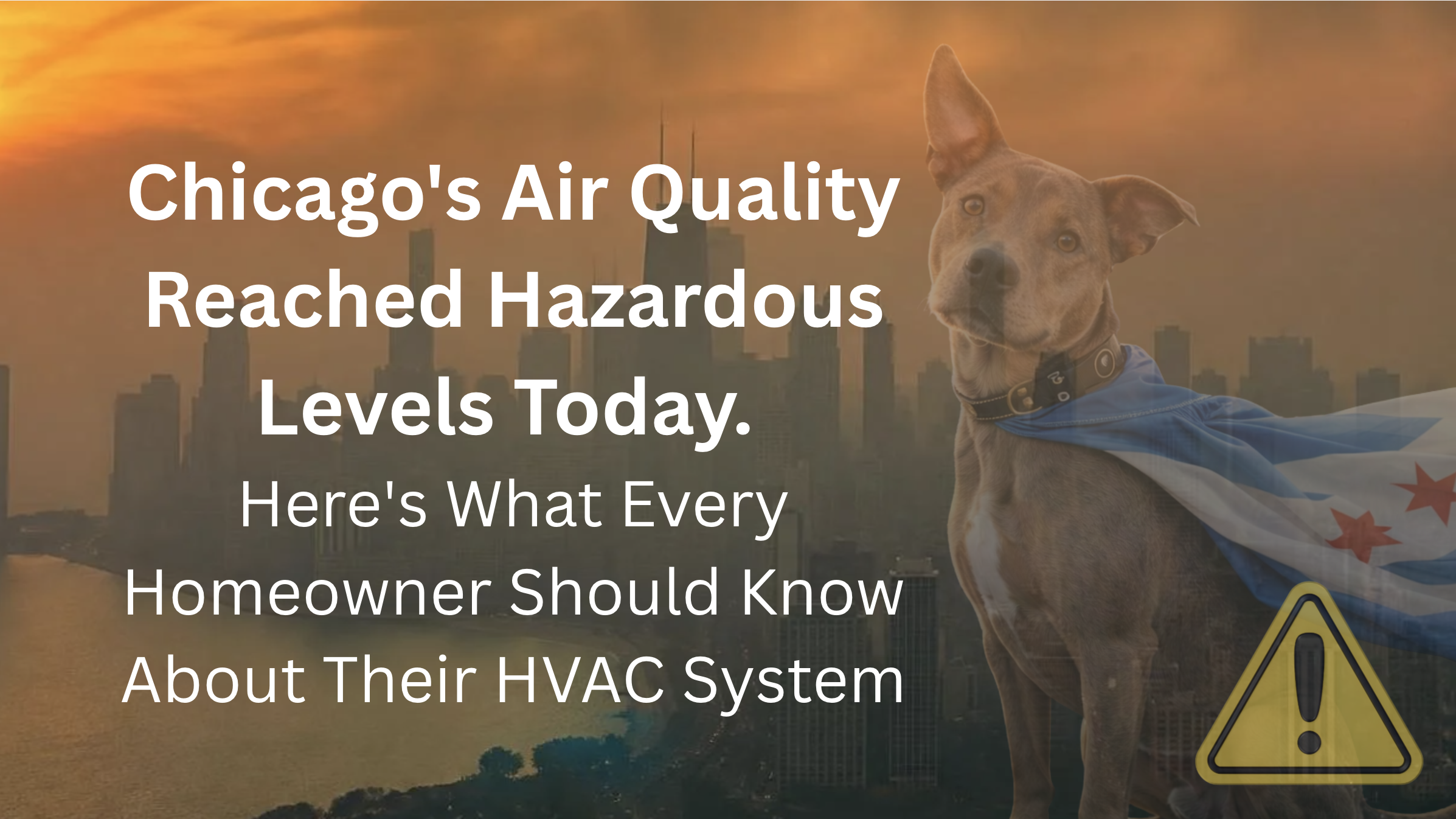
If you stepped outside anywhere in the Chicago area today, you probably noticed it right away. The sky looked hazy, the air smelled like smoke, and visibility wasn’t what it normally is.
That’s because smoke from more than 180 active wildfires burning in northern Ontario, along with additional fires in Minnesota, has drifted into northern Illinois. A weather pattern with light winds and stable air has trapped that smoke near the ground, causing air quality to deteriorate across much of the region. At various points throughout the day, parts of the Chicago area reached the Hazardous category on the Air Quality Index, prompting Air Quality Alerts and health advisories.
Most of the discussion has centered around protecting your lungs, but many homeowners have been asking another important question.
What does this mean for my HVAC system?
The good news is that wildfire smoke doesn’t damage your air conditioner. However, it can affect your indoor air quality, cause your HVAC filter to load up much faster than normal, and make your system work harder if it isn’t properly maintained.
Here’s what every homeowner should know.
Why Today’s Smoke Is Different
This isn’t the typical summer haze or pollution from traffic.
The smoke affecting Chicago today contains microscopic particles known as PM2.5. These particles are created when forests burn and are small enough to travel hundreds of miles through the atmosphere. They’re also small enough to enter your lungs, which is why public health officials recommend limiting outdoor activity when concentrations become elevated.
While much of the concern is about your health, these tiny particles also have an impact inside your home.
Does Your Air Conditioner Bring Smoke Into Your House?
This is one of the biggest misconceptions we hear.
Your outdoor air conditioning unit does not pull smoky outdoor air into your home’s ductwork. Its job is simply to release heat from inside your home.
However, smoke can still make its way indoors through small gaps around doors and windows, attic penetrations, bathroom exhaust fans, dryer vents, fireplaces, or fresh-air ventilation systems. Once those particles are inside, your HVAC system becomes one of the primary tools for filtering the air that circulates throughout your home.
That’s why your air filter is so important during events like today’s.
Your HVAC Filter Is Working Overtime
Wildfire smoke contains millions of extremely fine airborne particles.
As your HVAC system circulates air through your home, your filter captures many of those particles before the air is sent back through your vents. The more smoke in the air, the harder your filter has to work.
That means a filter that would normally last two or three months may become dirty much sooner during an extended smoke event.
As the filter loads with debris, airflow becomes more restricted. Reduced airflow can cause your air conditioner to run longer, reduce efficiency, and place additional strain on your system.
Should You Change Your Filter?
Not necessarily today, but you should check it once conditions improve.
If your filter is only a few weeks old, it’s probably fine.
If it’s already been one or two months since your last replacement, today’s smoke may shorten its remaining life. Once the air clears, remove the filter and inspect it. If it appears heavily loaded with gray dust or airflow through your home seems weaker than usual, replacing it is an inexpensive way to improve both indoor air quality and HVAC performance.
Is a Higher-Quality Filter Worth It?
It can be.
Many inexpensive fiberglass filters are designed primarily to protect HVAC equipment, not improve the air you breathe.
Pleated filters with higher MERV ratings capture much smaller particles.
As a general guideline:
- MERV 8 provides good protection against common household dust.
- MERV 11 captures more pollen, smoke particles, and other fine debris.
- MERV 13 offers excellent filtration for wildfire smoke, provided your HVAC system is designed to accommodate the additional airflow resistance.
Before switching to a higher-rated filter, check your equipment manufacturer’s recommendations or speak with an HVAC professional. Using a filter that’s too restrictive for your system can reduce airflow.
Should You Leave the Fan Running?
Many homeowners wonder if they should switch their thermostat fan from AUTO to ON.
Running the fan continuously allows more air to pass through the filter, which can help remove smoke particles already inside your home.
The tradeoff is increased electricity usage and a filter that will need replacement sooner.
If your thermostat has a Circulate setting, it often provides the best balance by periodically running the fan without operating continuously.
Why Your AC May Be Running Longer
If it feels like your air conditioner has been running almost nonstop today, the smoke itself usually isn’t the direct cause.
Instead, homeowners are keeping windows and doors closed, reducing natural ventilation while trying to maintain comfortable indoor temperatures. If your filter is also becoming loaded with fine smoke particles, reduced airflow can make cooling less efficient and increase run times.
A clean filter gives your system the best chance to perform efficiently during extreme weather events.
What About the Outdoor Unit?
Fortunately, wildfire smoke generally doesn’t harm your outdoor condenser.
If the smoke event lasts several days, you may notice a light coating of ash or debris around the unit. Once conditions improve, simply inspect the area and remove any visible buildup around the equipment.
Routine maintenance is usually all that’s required.
Simple Steps Chicago Homeowners Should Take Today
If you’re in the Chicago area while wildfire smoke continues to affect air quality:
- Keep windows and doors closed.
- Continue using your air conditioner normally.
- Make sure your thermostat is cooling as usual.
- Check your HVAC filter after the smoke event passes.
- Replace the filter if it’s dirty or restricting airflow.
- Consider using a portable HEPA air purifier, especially if someone in your home has asthma, allergies, or another respiratory condition.
- Limit introducing outdoor air into your home until local air quality improves.
The Bottom Line
Today’s hazardous air quality is a reminder that your HVAC system does much more than cool your home. It also plays an important role in maintaining the quality of the air your family breathes.
While your air conditioner isn’t being damaged by the wildfire smoke affecting Chicago today, your HVAC filter is working harder than usual to capture fine airborne particles. Making sure that filter is clean and your system has proper airflow can improve comfort, protect your equipment, and help maintain healthier indoor air while outdoor conditions remain poor.
If you have questions about your home’s airflow, indoor air quality, or whether your HVAC system is performing as it should, the team at Windy City HVAC Repair is always happy to help homeowners throughout Chicago and the surrounding suburbs make informed decisions about their heating and cooling systems.
Concerned About Your Home’s Air Quality?
If your air conditioner has been running nonstop, you’re unsure whether your HVAC filter is doing its job, or you’d simply like peace of mind during Chicago’s wildfire smoke event, we’re here to help.
At Windy City HVAC Repair, we help homeowners throughout Chicago and the surrounding suburbs keep their heating and cooling systems operating efficiently while improving indoor comfort and air quality. Whether you need a filter recommendation, a system inspection, or want to make sure your HVAC equipment is performing at its best, our experienced technicians are happy to answer your questions.
Give us a call today to schedule your HVAC inspection or service appointment.
Or contact us online to schedule an appointment at a time that’s convenient for you.
Because when the air outside isn’t safe to breathe, you should have confidence in the air inside your home.